Saturday, May 21, 2016

American History; the Alamo: the Real Story (Wild West History Documentary)


THE ALAMO: THE REAL STORY (WILD WEST HISTORY DOCUMENTARY)


The Battle of the Alamo (February 23 – March 6, 1836) was a pivotal event in the Texas Revolution. Following a 13-day siege, Mexican troops under President General Antonio López de Santa Anna launched an assault on the Alamo Mission near San Antonio de Béxar (modern-day San Antonio, Texas, United States), killing all of the Texian defenders. Santa Anna's cruelty during the battle inspired many Texians—both Texas settlers and adventurers from the United States—to join the Texian Army. Buoyed by a desire for revenge, the Texians defeated the Mexican Army at the Battle of San Jacinto, on April 21, 1836, ending the revolution.

This is a drawing of the Alamo Mission in San Antonio. It was first printed in 1854 in Gleason's Pictorial Drawing Room Companion

Several months previously, Texians had driven all Mexican troops out of Mexican Texas. About 100 Texians were then garrisoned at the Alamo. The Texian force grew slightly with the arrival of reinforcements led by eventual Alamo co-commanders James Bowie and William B. Travis. On February 23, approximately 1,500 Mexicans marched into San Antonio de Béxar as the first step in a campaign to retake Texas. For the next 10 days the two armies engaged in several skirmishes with minimal casualties. Aware that his garrison could not withstand an attack by such a large force, Travis wrote multiple letters pleading for more men and supplies, but fewer than 100 reinforcements arrived there.


In the early morning hours of March 6, the Mexican Army advanced on the Alamo. After repulsing two attacks, the Texians were unable to fend off a third attack. As Mexican soldiers scaled the walls, most of the Texian soldiers withdrew into interior buildings. Defenders unable to reach these points were slain by the Mexican cavalry as they attempted to escape. Between five and seven Texians may have surrendered; if so, they were quickly executed. Most eyewitness accounts reported between 182 and 257 Texians died, while most historians of the Alamo agree that around 600 Mexicans were killed or wounded. Several noncombatants were sent to Gonzales to spread word of the Texian defeat. The news sparked both a strong rush to join the Texian army and a panic, known as "The Runaway Scrape", in which the Texian army, most settlers, and the new Republic of Texas government fled from the advancing Mexican Army.


Within Mexico, the battle has often been overshadowed by events from the Mexican–American War of 1846–48. In 19th-century Texas, the Alamo complex gradually became known as a battle site rather than a former mission. The Texas Legislature purchased the land and buildings in the early part of the 20th century and designated the Alamo chapel as an official Texas State Shrine. The Alamo is now "the most popular tourist site in Texas".The Alamo has been the subject of numerous non-fiction works beginning in 1843. Most Americans, however, are more familiar with the myths spread by many of the movie and television adaptations, including the 1950s Disney miniseries Davy Crockett and John Wayne's 1960 film The Alamo.

Credits: Wikipedia

Friday, May 6, 2016

History Documentary: The Mexican - American War Mexican War (1846 to 1848); Full Documentary: the U.S.–Mexican War, or the Invasion of Mexico


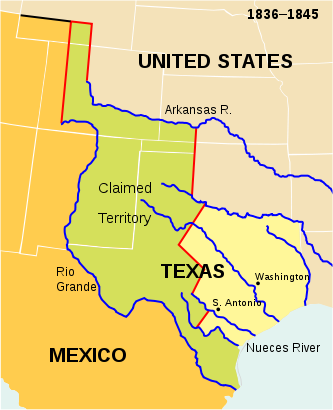
The Mexican–American War, also known as the Mexican War, the U.S.–Mexican War or the Invasion of Mexico, was an armed conflict between the United States of America and the United Mexican States from 1846 to 1848. It followed in the wake of the 1845 US annexation of Texas, which Mexico considered part of its territory, despite the 1836 Texas Revolution.

The Republic of Texas. The present-day outlines of the individual US states are superimposed on the boundaries of 1836–1845.

After its independence in 1821 and brief experiment with monarchy, Mexico became a republic in 1824, characterized by considerable instability, so that when war broke out in 1846, Mexico was ill-prepared for this conflict. The war with the United States followed in the wake of decades of Indian raids in the sparsely settled north of Mexico, which the avenger government-sponsored American migration to the Mexican province of Texas was aimed at buffering. Americans and some Mexicans revolted against the Mexican government in the 1836 Texas Revolution, creating a republic not recognized by Mexico, which still claimed it as its national territory. The 1845 expansion of US territory with its annexation of Texas escalated the dispute between the United States and Mexico to open war.

In 1844 James K. Polk, the newly-elected president, made a proposition to the Mexican government to purchase the disputed lands. When that offer was rejected, troops from the United States were moved into the disputed territory of Coahuila. These troops were then attacked by Mexican troops, killing 12 American troops and taking 52 prisoners. These same Mexican troops later laid siege to a US fort along the Rio Grande. This would lead to the conflict that resulted in the loss of much of Mexico's northern territory.

US forces quickly occupied Santa Fe de Nuevo México and Alta California Territory, then invaded parts of Northeastern Mexico and Northwest Mexico; meanwhile, the Pacific Squadron conducted a blockade, and took control of several garrisons on the Pacific coast farther south in Baja California Territory. Another American army, under the command of General Winfield Scott, captured the capital Mexico City, marching from the port of Veracruz, virtually unopposed.

The 1848 Treaty of Guadalupe Hidalgo ended and specified the major consequence of the war: the Mexican Cession of the territories of Alta California and Santa Fe de Nuevo México to the United States in exchange for $15 million. In addition, the United States assumed $3.25 million of debt owed by the Mexican government to US citizens. Mexico recognized the loss of Texas and thereafter cited the Rio Grande as its national border with the United States.

American territorial expansion to the Pacific coast had been the goal of US President James K. Polk, the leader of the Democratic Party. The war was highly controversial in the United States, with the Whig Party, anti-imperialists and anti-slavery elements strongly opposed. Critics in the United States pointed to heavy casualties of the US forces and high monetary cost of the conflict. The war intensified the slavery issue in the United States, leading to bitter debates that culminated in the bloody American Civil War.

In Mexico, the war came in the middle of political turmoil, which increased into chaos during the conflict. The military defeat and loss of territory was a disastrous blow, causing Mexico to enter "a period of self-examination ... as its leaders sought to identify and address the reasons that had led to such a debacle." In the immediate aftermath of the war, some prominent Mexicans wrote that the war that resulted in "the state of degradation and ruin" in Mexico, and saw for "the true origin of the war, it is sufficient to say that the insatiable ambition of the United States, favored by our weakness, caused it." The shift in the Mexico-U.S. border left many Mexican citizens separated from their national government. For the indigenous peoples who had never accepted Mexican rule, the change in border meant conflicts with a new outside power.

Friday, April 29, 2016

History Documentary: The Etruscans, Lost Ancient Civilzation- Full documentary: The Etruscan Civilization


The Etruscan civilization (/ᵻˈtrʌskən/) is the modern name given to a civilization of ancient Italy in the area corresponding roughly to Tuscany, western Umbria, and northern Lazio. The ancient Romans called its creators the Tusci or Etrusci. Their Roman name is the origin of the terms Tuscany, which refers to their heartland, and Etruria, which can refer to their wider region.

In Attic Greek, the Etruscans were known as Tyrrhenians (Τυρρηνοὶ, Tyrrhēnoi), earlier Tyrsenoi, from which the Romans derived the names Tyrrhēni, Tyrrhēnia (Etruria), and Mare Tyrrhēnum (Tyrrhenian Sea),prompting some to associate them with the Teresh (Sea Peoples). The word may also be related to the Hittite Taruisa (gr. Tursha).The Etruscans called themselves Rasenna, which was syncopated to Rasna or Raśna.

As distinguished by its unique language, this civilization endured from before the time of the earliest Etruscan inscriptions (c. 700 BC) until its assimilation into the Roman Republic in the late 4th century BC.

At its maximum extent, during the foundational period of Rome and the Roman Kingdom, Etruscan civilization flourished in three confederacies of cities: of Etruria, of the Po Valley with the eastern Alps, and of Latium and Campania.

Culture that is identifiably Etruscan developed in Italy after about 800 BC approximately over the range of the preceding Iron Age Villanovan culture. The latter gave way in the 7th century to a culture that was influenced by ancient Greece, Magna Graecia, and Phoenicia.

After 500 BC, the political destiny of Italy passed out of Etruscan hands.

The latest mitochondrial DNA study (2013) shows that Etruscans appear to fall very close to a Neolithic population from Central Europe and to other Tuscan populations.
Credits: Wikipedia

Extent of Etruscan civilization and the twelve Etruscan League cities.

Friday, April 22, 2016

Historian Channel: The Real Wild West: Wild Bill, History Documentary. American History: Wild Bill, Full Documentary


James Butler Hickok (May 27, 1837 – August 2, 1876)—known as "Wild Bill" Hickok—was a folk character of the American Old West. Some of his exploits as reported at the time were fiction, but his skill as a gunfighter and gambler provided the basis for his fame, along with his reputation as a lawman.

James Butler Hickok (May 27, 1837 – August 2, 1876)—known as "Wild Bill" Hickok—

Hickok was born and raised on a farm in rural Illinois. He went west at age 18 as a fugitive from justice, first working as a stagecoach driver, then as a lawman in the frontier territories of Kansas and Nebraska. He fought (and spied) for the Union Army during the American Civil War and gained publicity after the war as a scout, marksman, actor and professional gambler. Hickok was involved in several notable shootouts.

He was shot from behind and killed while playing poker in a saloon in Deadwood, Dakota Territory (now South Dakota) by an unsuccessful gambler, Jack McCall. The card hand which he supposedly held at the time of his death (aces and eights) has come to be known as the "Dead Man's Hand."
Credits: Wikipedia

Saturday, April 9, 2016

History Documentary: The New World, Colonial history of the United States of America; American History, Full Documentary, Historian Channel


History Documentary: The New World, Colonial history of the United States of America; American History, Full Documentary, Historian Channel.
Colonial Williamsburg,  View of the reconstructed Raleigh Tavern
on Duke of Gloucester Street

This documentary traces the discovery of America and early voyages by European explorers. It shows Indian civilizations encountered by the Spanish, Spanish colonization, English freebooters on the Spanish Main, and the life of early settlers in New England and the South.

The colonial history of the United States covers the history of European settlements from the start of colonization of America until their incorporation into the United States. In the late 16th century, England, France, Spain and the Netherlands launched major colonization programs in eastern North America. Small early attempts often disappeared; everywhere the death rate of the first arrivals was very high. Nevertheless successful colonies were established. European settlers came from a variety of social and religious groups. No aristocrats settled permanently, but a number of adventurers, soldiers, farmers, and tradesmen arrived. Diversity was an American characteristic as the Dutch of New Netherland, the Swedes and Finns of New Sweden, the English Quakers of Pennsylvania, the English Puritans of New England, the English settlers of Jamestown, and the "worthy poor" of Georgia, came to the new continent and built colonies with distinctive social, religious, political and economic styles. Non-British colonies were taken over and the inhabitants were all assimilated, unlike in Nova Scotia, where the British expelled the French Acadian inhabitants. There were no major civil wars among the 13 colonies, and the two chief armed rebellions (in Virginia in 1676 and in New York in 1689–91) were short-lived failures. Wars between the French and the British—the French and Indian Wars and Father Rale's War—were recurrent, and involved French support for Wabanaki Confederacy attacks on the frontiers. By 1760 France was defeated and the British seized its colonies.

On the eastern seaboard of what would become the United States, the four distinct British regions were: New England, the Middle Colonies, the Chesapeake Bay Colonies (Upper South) and the Lower South. By the time European settlers arrived around 1600–1650, the majority of the Native Americans living in the eastern United States had been ravaged by new diseases, introduced to them decades before by explorers and sailors.

Colonizers came from European kingdoms with highly developed military, naval, governmental and entrepreneurial capabilities. The Spanish and Portuguese centuries-old experience of conquest and colonization during the Reconquista, coupled with new oceanic ship navigation skills, provided the tools, ability, and desire to colonize the New World. England, France and the Netherlands started colonies in both the West Indies and North America. They had the ability to build ocean-worthy ships, but did not have as strong a history of colonization in foreign lands as did Portugal and Spain. However, English entrepreneurs gave their colonies a base of merchant-based investment that needed much less government support.

English colonies:
England made its first successful efforts at the start of the 17th century for several reasons. During this era, English proto-nationalism and national assertiveness blossomed under the threat of Spanish invasion, assisted by a degree of Protestant militarism and the energy of Queen Elizabeth. At this time, however, there was no official attempt by the English government to create a colonial empire. Rather, the motivation behind the founding of colonies was piecemeal and variable. Practical considerations, such as commercial enterprise, overpopulation and the desire for freedom of religion, played their parts. The main waves of settlement came in the 17th century. After 1700 most immigrants to Colonial America arrived as indentured servants—young unmarried men and women seeking a new life in a much richer environment. Between the late 1610s and the American Revolution, the British shipped an estimated 50,000 convicts to its American colonies. The first convicts to arrive pre-dated the arrival of the Mayflower.

New England:
New England is the oldest clearly defined region of the United States. While New England was originally inhabited by Indigenous peoples, English Pilgrims and especially Puritans, fleeing religious persecution in England, arrived in the 1620-1660 era. They dominated the region; their religion was later called Congregationalism. They and their descendants are called Yankees. Farming, fishing and lumbering prospered, as did seafaring and merchandising.

Saturday, April 2, 2016

The Historian Channel: History of protestant reformation and Martin Luther, Full Documentary; History of protestant reformation and Martin Luther, History Documentary


The Historian Channel: History of protestant reformation and Martin Luther, Full Documentary; History of protestant reformation and Martin Luther, History Documentary


The Protestant Reformation, often referred to simply as the Reformation (from Latin reformatio, lit. "restoration, renewal"), was a schism from the Roman Catholic Church initiated by Martin Luther and continued by John Calvin, Huldrych Zwingli and other early Protestant Reformers in the 16th century Europe.

Although there had been significant earlier attempts to reform the Roman Catholic Church before Luther — such as those of Jan Hus, Peter Waldo, and John Wycliffe — Martin Luther is widely acknowledged to have started the Reformation with his 1517 work The Ninety-Five Theses. Luther began by criticizing the selling of indulgences, insisting that the Pope had no authority over purgatory and that the Catholic doctrine of the merits of the saints had no foundation in the gospel. The Protestant position, however, would come to incorporate doctrinal changes such as sola scriptura and sola fide. The core motivation behind these changes was theological, though many other factors played a part, including the rise of nationalism, the Western Schism which eroded people's faith in the Papacy, the perceived corruption of the Roman Curia, the impact of humanism and the new learning of the Renaissance which questioned much of the traditional thought.

The initial movement within Germany diversified almost right then and there, and other reform impulses arose independently of Luther. The spread of Gutenberg's printing press provided the means for the rapid dissemination of religious materials in the vernacular. The largest groups were the Lutherans and Calvinists. Lutheran churches were founded mostly in Germany, the Baltics and Scandinavia, while the Reformed ones were founded in Switzerland, Hungary, France, the Netherlands and Scotland. The new movement influenced the Church of England decisively after 1547 under Edward VI and Elizabeth I, although the national church had been made independent under Henry VIII in the early 1530s for political rather than religious reasons.

There were also reformation movements throughout continental Europe known as the Radical Reformation, which gave rise to the Anabaptist, Moravian, and other Pietistic movements. Radical Reformers, besides forming communities outside state sanction, often employed more extreme doctrinal change, such as the rejection of tenets of the councils of Nicaea and Chalcedon.

The Roman Catholic Church responded with a Counter-Reformation initiated by the Council of Trent. Much work in battling Protestantism was done by the well-organized new order of the Jesuits. In general, Northern Europe, with the exception of most of Ireland, came under the influence of Protestantism. Southern Europe remained Roman Catholic, although Greece remained predominantly Eastern Orthodox, while Central Europe was a site of a fierce conflict, culminating in the Thirty Years' War, which left it massively devastated.
Credits: Wikipedia
Martin Luther, shown in a portrait by Lucas Cranach the Elder, initiated the Protestant Reformation in 1517.

Friday, March 25, 2016

History Documentary: The Soviet war in Afghanistan (1979-1989) - Full Documentary, USSR - Afghanistan War and the Mujahideen


The Soviet–Afghan War lasted over nine years from December 1979 to February 1989. Insurgent groups ("the Mujahideen"), who received aid from both Christian and Muslim countries, fought against the Soviet Army and allied Afghan forces. Between 850,000–1.5 million civilians were killed and millions of Afghans fled the country as refugees, mostly to Pakistan and Iran.

Prior to the arrival of Soviet troops, the pro-Soviet Nur Mohammad Taraki government took power in a 1978 coup and initiated a series of radical modernization reforms throughout the country. Vigorously suppressing any opposition from among the traditional Muslim Afghans, the government arrested thousands and executed as many as 27,000 political prisoners. By April 1979 large parts of the country were in open rebellion and by December the government had lost control of territory outside of the cities. In response to Afghan government requests, the Soviet government under leader Leonid Brezhnev first sent covert troops to advise and support the Afghani government, but on December 24, 1979, began the first deployment of the 40th Army.
Arriving in the capital Kabul, they staged a coup, killing the Afghan President, and installing a rival Afghan socialist (Babrak Karmal).
In January 1980, foreign ministers from 34 nations of the Islamic Conference adopted a resolution demanding "the immediate, urgent and unconditional withdrawal of Soviet troops" from Afghanistan, while the UN General Assembly passed a resolution protesting the Soviet intervention by a vote of 104–18. Afghan insurgents began to receive massive amounts of aid, military training in neighboring Pakistan and China, paid for primarily by the United States and Arab monarchies in the Persian Gulf.[

Soviet troops occupied the cities and main arteries of communication, while the mujahideen waged guerrilla war in small groups operating in the almost 80 percent of the country that escaped government and Soviet control. Soviets used their air power to deal harshly with both rebels and civilians, leveling villages to deny safe haven to the enemy, destroying vital irrigation ditches, and laying millions of land mines.

 By the mid-1980s the Soviet contingent was increased to 108,800 and fighting increased throughout the country, but the military and diplomatic cost of the war to the USSR was high. By mid-1987 the Soviet Union, now under reformist leader Mikhail Gorbachev, announced it would start withdrawing its forces. The final troop withdrawal started on May 15, 1988, and ended on February 15, 1989.
Credits: Wikipedia
  
Mujahideen in Kunar, Afghanistan. Mortar attack on Shigal Tarna garrison, Kunar Province, 1987.