Showing posts with label Mexico. Show all posts

Friday, September 23, 2016

History Documentary: Teotihuacan, the Aztecs. Pyramids of Death: Teotihuacan, Mexico. Teotihuacan: the Pyramid of the Sun and the Pyramid of the Moon


Unravel the mysteries surrounding the rise and fall of one of the ancient world's most powerful and least understood civilizations, the Teotihuacan.


View of the Avenue of the Dead and the Pyramid of the Sun, from the Pyramid of the Moon.


Teotihuacan /teɪˌoʊtiːwəˈkɑːn/,[1] also written Teotihuacán (Spanish pronunciation: [teotiwa'kan] ( listen)), was an ancient Mesoamerican city located in a sub-valley of the Valley of Mexico, located in the State of Mexico 40 kilometres (25 mi) northeast of modern-day Mexico City, known today as the site of many of the most architecturally significant Mesoamerican pyramids built in the pre-Columbian Americas.

At its zenith, perhaps in the first half of the 1st millennium AD, Teotihuacan was the largest city in the pre-Columbian Americas, with a population estimated at 125,000 or more, making it at least the sixth largest city in the world during its epoch.

Apart from the pyramids, Teotihuacan is also anthropologically significant for its complex, multi-family residential compounds; the Avenue of the Dead; and the small portion of its vibrant murals that have been exceptionally well-preserved. Additionally, Teotihuacan exported fine obsidian tools that garnered high prestige and widespread usage throughout Mesoamerica.

The city is thought to have been established around 100 BC, with major monuments continuously under construction until about 250 AD. The city may have lasted until sometime between the 7th and 8th centuries AD, but its major monuments were sacked and systematically burned around 550 AD.

Teotihuacan began as a new religious center in the Mexican Highlands around the first century AD. This city came to be the largest and most populated center in the pre-Columbian Americas. Teotihuacan was even home to multi-floor apartment compounds built to accommodate this large population. The term Teotihuacan (or Teotihuacano) is also used for the whole civilization and cultural complex associated with the site.

Although it is a subject of debate whether Teotihuacan was the center of a state empire, its influence throughout Mesoamerica is well documented; evidence of Teotihuacano presence can be seen at numerous sites in Veracruz and the Maya region. The later Aztecs saw these magnificent ruins and claimed a common ancestry with the Teotihuacanos, modifying and adopting aspects of their culture. The ethnicity of the inhabitants of Teotihuacan is also a subject of debate. Possible candidates are the Nahua, Otomi, or Totonac ethnic groups. Scholars have also suggested that Teotihuacan was a multi-ethnic state.

The city and the archaeological site are located in what is now the San Juan Teotihuacán municipality in the State of México, approximately 40 kilometres (25 mi) northeast of Mexico City. The site covers a total surface area of 83 square kilometres (32 sq mi) and was designated a UNESCO World Heritage Site in 1987. It is the most visited archaeological site in Mexico.

Friday, June 10, 2016

The Historian Channel: The Maya, Aztec, Olmec, History Documentry, Ancient Americans The Mayas, Aztecs, Olmecs


The Historian Channel: The Maya, Aztec, Olmec, History Documentry,  Ancient Americans The Mayas, Aztecs, Olmecs.

Olmec jadeite mask 1000–600 BCE

The Olmecs were the first major civilization in Mexico following a progressive development in Soconusco. They lived in the tropical lowlands of south-central Mexico, in the present-day states of Veracruz and Tabasco. It has been speculated that Olmec derive in part from neighboring Mokaya and/or Mixe–Zoque.

The population of the Olmecs flourished during Mesoamerica's formative period, dating roughly from as early as 1500 BCE to about 400 BCE. Pre-Olmec cultures had flourished in the area since about 2500 BCE, but by 1600–1500 BCE, early Olmec culture had emerged, centered on the San Lorenzo Tenochtitlán site near the coast in southeast Veracruz. They were the first Mesoamerican civilization and laid many of the foundations for the civilizations that followed. Among other "firsts", the Olmec appeared to practice ritual bloodletting and played the Mesoamerican ballgame, hallmarks of nearly all subsequent Mesoamerican societies.

The aspect of the Olmecs most familiar now is their artwork, particularly the aptly named "colossal heads". The Olmec civilization was first defined through artifacts which collectors purchased on the pre-Columbian art market in the late 19th century and early 20th century. Olmec artworks are considered among ancient America's most striking.
Source: Wikipedia

Saturday, May 21, 2016

History Documentary: The Mayas, History of Ball Games; Rubber Balls in Mexico: a Mayan Tradition. The Mesoamerican ballgame


The Mesoamerican ballgame (ōllamaliztli in Nahuatl (Nahuatl pronunciation: [oːlːamaˈlistɬi]), pitz in Classical Maya, modern Spanish "El juego de la pelota") was a sport with ritual associations played since 1,400 BC by the pre-Columbian peoples of Ancient Mesoamerica. The sport had different versions in different places during the millennia, and a newer more modern version of the game, ulama, is still played in a few places by the indigenous population.
 
The rules of ōllamaliztli are not known, but judging from its descendant, ulama, they were probably similar to racquetball, where the aim is to keep the ball in play. The stone ballcourt goals are a late addition to the game.

Map showing sites where early ballcourts, balls, or figurines have been recovered

In the most common theory of the game, the players struck the ball with their hips, although some versions allowed the use of forearms, rackets, bats, or handstones. The ball was made of solid rubber and weighed as much as 4 kg (9 lbs), and sizes differed greatly over time or according to the version played.

The game had important ritual aspects, and major formal ballgames were held as ritual events, often featuring human sacrifice. The sport was also played casually for recreation by children and perhaps even women.

Pre-Columbian ballcourts have been found throughout Mesoamerica, as for example at Copán, as far south as modern Nicaragua, and possibly as far north as what is now the U.S. state of Arizona. These ballcourts vary considerably in size, but all have long narrow alleys with slanted side-walls against which the balls could bounce.

Source: Wikipedia

Friday, May 6, 2016

History Documentary: The Mexican - American War Mexican War (1846 to 1848); Full Documentary: the U.S.–Mexican War, or the Invasion of Mexico


The Mexican–American War, also known as the Mexican War, the U.S.–Mexican War or the Invasion of Mexico, was an armed conflict between the United States of America and the United Mexican States from 1846 to 1848. It followed in the wake of the 1845 US annexation of Texas, which Mexico considered part of its territory, despite the 1836 Texas Revolution.

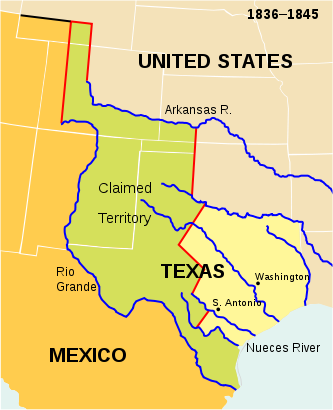
The Republic of Texas. The present-day outlines of the individual US states are superimposed on the boundaries of 1836–1845.

After its independence in 1821 and brief experiment with monarchy, Mexico became a republic in 1824, characterized by considerable instability, so that when war broke out in 1846, Mexico was ill-prepared for this conflict. The war with the United States followed in the wake of decades of Indian raids in the sparsely settled north of Mexico, which the avenger government-sponsored American migration to the Mexican province of Texas was aimed at buffering. Americans and some Mexicans revolted against the Mexican government in the 1836 Texas Revolution, creating a republic not recognized by Mexico, which still claimed it as its national territory. The 1845 expansion of US territory with its annexation of Texas escalated the dispute between the United States and Mexico to open war.

In 1844 James K. Polk, the newly-elected president, made a proposition to the Mexican government to purchase the disputed lands. When that offer was rejected, troops from the United States were moved into the disputed territory of Coahuila. These troops were then attacked by Mexican troops, killing 12 American troops and taking 52 prisoners. These same Mexican troops later laid siege to a US fort along the Rio Grande. This would lead to the conflict that resulted in the loss of much of Mexico's northern territory.

US forces quickly occupied Santa Fe de Nuevo México and Alta California Territory, then invaded parts of Northeastern Mexico and Northwest Mexico; meanwhile, the Pacific Squadron conducted a blockade, and took control of several garrisons on the Pacific coast farther south in Baja California Territory. Another American army, under the command of General Winfield Scott, captured the capital Mexico City, marching from the port of Veracruz, virtually unopposed.

The 1848 Treaty of Guadalupe Hidalgo ended and specified the major consequence of the war: the Mexican Cession of the territories of Alta California and Santa Fe de Nuevo México to the United States in exchange for $15 million. In addition, the United States assumed $3.25 million of debt owed by the Mexican government to US citizens. Mexico recognized the loss of Texas and thereafter cited the Rio Grande as its national border with the United States.

American territorial expansion to the Pacific coast had been the goal of US President James K. Polk, the leader of the Democratic Party. The war was highly controversial in the United States, with the Whig Party, anti-imperialists and anti-slavery elements strongly opposed. Critics in the United States pointed to heavy casualties of the US forces and high monetary cost of the conflict. The war intensified the slavery issue in the United States, leading to bitter debates that culminated in the bloody American Civil War.

In Mexico, the war came in the middle of political turmoil, which increased into chaos during the conflict. The military defeat and loss of territory was a disastrous blow, causing Mexico to enter "a period of self-examination ... as its leaders sought to identify and address the reasons that had led to such a debacle." In the immediate aftermath of the war, some prominent Mexicans wrote that the war that resulted in "the state of degradation and ruin" in Mexico, and saw for "the true origin of the war, it is sufficient to say that the insatiable ambition of the United States, favored by our weakness, caused it." The shift in the Mexico-U.S. border left many Mexican citizens separated from their national government. For the indigenous peoples who had never accepted Mexican rule, the change in border meant conflicts with a new outside power.

Monday, June 29, 2015

The Mexican–American War, also known as the Mexican War: Full Documentary. The U.S.–Mexican War (or the Invasion of Mexico), History Documentary


The Republic of Texas. The present-day outlines of the U.S. states are superimposed on the boundaries of 1836–1845.

The Mexican–American War, also known as the Mexican War, the U.S.–Mexican War or the Invasion of Mexico, was an armed conflict between the United States and the Centralist Republic of Mexico (which became the Second Federal Republic of Mexico during the war) from 1846 to 1848. It followed in the wake of the 1845 U.S. annexation of Texas, which Mexico considered part of its territory, despite the 1836 Texas Revolution. It was the fourth of the five major wars fought on American soil which was preceded by the Seven Years' War, the American Revolutionary War and the War of 1812 and succeeded by the American Civil War.

Combat operations lasted a year and a half, from the spring of 1846 to the fall of 1847. American forces quickly occupied New Mexico and California, then invaded parts of Northeastern Mexico and Northwest Mexico; meanwhile, the Pacific Squadron conducted a blockade, and took control of several garrisons on the Pacific coast farther south in Baja California. Another American army captured Mexico City, and the war ended in a victory for the United States.

The Treaty of Guadalupe Hidalgo ended and specified the major consequence of the war: the forced Mexican Cession of the territories of Alta California and Santa Fe de Nuevo México to the United States in exchange for $15 million. In addition, the United States assumed $3.25 million of debt owed by the Mexican government to U.S. citizens. Mexico accepted the loss of Texas and thereafter cited the Rio Grande as its national border.


American territorial expansion to the Pacific coast had been the goal of President James K. Polk, the leader of the Democratic Party.[6] The war was, however, highly controversial in the United States, with the Whig Party, anti-imperialists and anti-slavery elements strongly opposed. Heavy American casualties and high monetary cost were also criticized. The political aftermath of the war raised the slavery issue in the United States, leading to intense debates that pointed to civil war; the Compromise of 1850 provided a brief respite.
Credits: Wikipedia

Sunday, June 14, 2015

Ancient Mexico, History Documentary: The Xi People (or Olmecs) Mother Civilization of the Americas, Documentary

Olmec jadeite mask 1000–600 BCE


Olmec alternative origin speculations are explanations that have been suggested for the formation of Olmec civilization which contradict generally accepted scholarly consensus. These origin theories typically involve contact with Old World societies. Although these speculations have become somewhat well-known within popular culture, particularly the idea of an African connection to the Olmec, they are not considered credible by the majority of researchers of Mesoamerica.
The great majority of scholars who specialize in Mesoamerican history, archaeology and linguistics remain unconvinced by alternative origin speculations. Many are more critical and regard the promotion of such unfounded theories as a form of ethnocentric racism at the expense of indigenous Americans. The consensus view maintained across publications in peer-reviewed academic journals that are concerned with Mesoamerican and other pre-Columbian research is that the Olmec and their achievements arose from influences and traditions that were wholly indigenous to the region, or at least the New World, and there is no reliable material evidence to suggest otherwise. They, and their neighbouring cultures with whom they had contact, developed their own characters which were founded entirely on a remarkably interlinked and ancient cultural and agricultural heritage that was locally shared, but arose quite independently of any extra-hemispheric influences.

African origins:
Some writers claim that the Olmecs were related to peoples of Africa based primarily on their interpretation of facial features of Olmec statues. They additionally contend that epigraphical, genetic, and osteological evidence supports their claims.[citation needed] The idea was first suggested by José Melgar, who discovered the first colossal head at Hueyapan (now Tres Zapotes) in 1862 and subsequently published two papers that attributed this head to a "Negro race." The view was espoused in the early 20th century by Leo Wiener and others.[6] Some modern proponents such as Ivan van Sertima and Clyde Ahmad Winters have identified the Olmecs with the Mandé people of West Africa.

Epigraphic evidence:
Some researchers claim that the Mesoamerican writing systems are related to African scripts. In the early 19th century, Constantine Samuel Rafinesque proposed that the Mayan inscriptions were probably related to the Libyco-Berber writing of Africa. Leo Wiener and others claim that various Olmec and Epi-Olmec symbols are similar to those found in the Vai script (a relatively modern script in Liberia which may have Cherokee influence), in particular, the symbols on the Tuxtla Statuette, Teo Mask,[citation needed] Cascajal Block,[citation needed] and the celts in Offering 4 at La Venta.

These assertions have found no support among Mesoamerican researchers. While mainstream scholars have made significant progress translating the Maya script, researchers have yet to translate Olmec glyphs.

Genetic evidence:

Genetic and immunological studies over the past two decades have failed to yield evidence of precolumbian African contributions to the indigenous populations of the Americas.
Credits: Wikipedia

Wednesday, June 10, 2015

The Olmecs, History Documentary: Secrets of the Ancient Olmecs, the Olmecs Stone Heads


Las Limas Monument, considered an important realization of Olmec mythology. The youth holds a were-jaguar infant, while four iconic supernaturals are incised on the youth's shoulders and knees.

The Olmec were the first major civilization in Mexico following a progressive development in Soconusco. They lived in the tropical lowlands of south-central Mexico, in the present-day states of Veracruz and Tabasco. It has been speculated that Olmec derive in part from neighboring Mokaya and/or Mixe–Zoque.

The Olmec flourished during Mesoamerica's formative period, dating roughly from as early as 1500 BCE to about 400 BCE. Pre-Olmec cultures had flourished in the area since about 2500 BCE, but by 1600–1500 BCE, Early Olmec culture had emerged, centered on the San Lorenzo Tenochtitlán site near the coast in southeast Veracruz. They were the first Mesoamerican civilization and laid many of the foundations for the civilizations that followed. Among other "firsts", the Olmec appeared to practice ritual bloodletting and played the Mesoamerican ballgame, hallmarks of nearly all subsequent Mesoamerican societies.


The aspect of the Olmecs most familiar now is their artwork, particularly the aptly named "colossal heads". The Olmec civilization was first defined through artifacts which collectors purchased on the pre-Columbian art market in the late 19th century and early 20th century. Olmec artworks are considered among ancient America's most striking.
Credits: Wikipedia