Showing posts with label Ancient China. Show all posts

Saturday, January 16, 2016

The Historian Channel: Acupuncture, Traditional Chinese Medicine, Documentary, The History of Acupuncture, Discovery History Health

The Historian Channel: Acupuncture, Traditional Chinese Medicine, Documentary, The History of Acupuncture, Discovery History Health 

Traditional and modern Japanese guiding tube needles
 
Early development in China, Establishment and growth:

In the first half of the 1st century AD, acupuncturists began promoting the belief that acupuncture's effectiveness was influenced by the time of day or night, the lunar cycle, and the season. The Science of the Yin-Yang Cycles (Yün Chhi Hsüeh) was a set of beliefs that curing diseases relied on the alignment of both heavenly (thien) and earthly (ti) forces that were attuned to cycles like that of the sun and moon. There were several different belief systems that relied on a number of celestial and earthly bodies or elements that rotated and only became aligned at certain times. According to Needham and Gwei-djen, these "arbitrary predictions" were depicted by acupuncturists in complex charts and through a set of special terminology.

Acupuncture needles during this period were much thicker than most modern ones and often resulted in infection. Infection is caused by a lack of sterilization, but at that time it was believed to be caused by use of the wrong needle, or needling in the wrong place, or at the wrong time. Later, many needles were heated in boiling water, or in a flame. Sometimes needles were used while they were still hot, creating a cauterizing effect at the injection site. Nine needles were recommended in the Chen Chiu Ta Chheng from 1601, which may have been because of an ancient Chinese belief that nine was a magic number.

Other belief systems were based on the idea that the human body operated on a rhythm and acupuncture had to be applied at the right point in the rhythm to be effective.[30]:140-141 In some cases a lack of balance between Yin and Yang were believed to be the cause of disease.

In the 1st century AD, many of the first books about acupuncture were published and recognized acupuncturist experts began to emerge. The Zhen Jiu Jia Yi Jing, which was published in the mid-3rd century, became the oldest acupuncture book that is still in existence in the modern era. Other books like the Yu Kuei Chen Ching, written by the Director of Medical Services for China, were also influential during this period, but were not preserved. In the mid 7th century, Sun Simiao published acupuncture-related diagrams and charts that established standardized methods for finding acupuncture sites on people of different sizes and categorized acupuncture sites in a set of modules.

Acupuncture became more established in China as improvements in paper led to the publication of more acupuncture books. The Imperial Medical Service and the Imperial Medical College, which both supported acupuncture, became more established and created medical colleges in every province. The public was also exposed to stories about royal figures being cured of their diseases by prominent acupuncturists. By time The Great Compendium of Acupuncture and Moxibustion was published during the Ming dynasty (1368–1644 AD), most of the acupuncture practices used in the modern era had been established.
Decline

By the end of the Song dynasty (1279 AD), acupuncture had lost much of its status in China. It became rarer in the following centuries, and was associated with less prestigious professions like alchemy, shamanism, midwifery and moxibustion. Additionally, by the 18th century, scientific rationality was becoming more popular than traditional superstitious beliefs. By 1757 a book documenting the history of Chinese medicine called acupuncture a "lost art". Its decline was attributed in part to the popularity of prescriptions and medications, as well as its association with the lower classes.

In 1822, the Chinese Emperor signed a decree excluding the practice of acupuncture from the Imperial Medical Institute. He said it was unfit for practice by gentlemen-scholars. In China acupuncture was increasingly associated with lower-class, illiterate practitioners. It was restored for a time, but banned again in 1929 in favor of science-based Western medicine. 
Credits: Wikipedia 

Monday, June 1, 2015

Full History Documentary: Imperial China, China's Empire: History Documentary

"Departure Herald", 26 m (85 ft) in length, from the Chinese Xuande reign period (1425-1435 AD); the painting shows the emperor's large procession heading towards the imperial tombs of the Ming emperors located roughly 50 km north of the capital Beijing.

ANCIENT
Neolithic c. 8500 – c. 2100 BC
Xia dynasty c. 2100 – c. 1600 BC
Shang dynasty c. 1600 – c. 1046 BC
Zhou dynasty c. 1045 – 256 BC
 Western Zhou
 Eastern Zhou
   Spring and Autumn
   Warring States
IMPERIAL
Qin dynasty 221–206 BC
Han dynasty 206 BC – 220 AD
  Western Han
  Xin dynasty
  Eastern Han
Three Kingdoms 220–280
  WeiShu and Wu
Jin dynasty 265–420
  Western Jin
  Eastern JinSixteen Kingdoms
Southern and Northern Dynasties
420–589
Sui dynasty 581–618
Tang dynasty 618–907
  (Wu Zhou interregnum 690–705)
Five Dynasties and
Ten Kingdoms

907–960
Liao dynasty
907–1125
Song dynasty
960–1279
  Northern SongW. Xia
  Southern SongJin
Yuan dynasty 1271–1368
Ming dynasty 1368–1644
Qing dynasty 1644–1911
MODERN
Republic of China 1912–1949
People's Republic
of China

1949–present
Republic of
China on Taiwan

1949–present

Written records of the history of China can be found from as early as 1200 BC under the Shang dynasty (c. 1600–1046 BC).Ancient historical texts such as the Records of the Grand Historian (ca. 100 BC) and the Bamboo Annals describe a Xia dynasty (c. 2070–1600 BC), which had no system of writing on a durable medium, before the Shang. The Yellow River is said to be the cradle of Chinese civilization, although cultures originated at various regional centers along both the Yellow River and the Yangtze River valleys millennia ago in the Neolithic era. With thousands of years of continuous history, China is one of the world's oldest civilizations.

Much of Chinese culture, literature and philosophy further developed during the Zhou dynasty (1046–256 BC). The Zhou dynasty began to bow to external and internal pressures in the 8th century BC, and the kingdom eventually broke apart into smaller states, beginning in the Spring and Autumn period and reaching full expression in the Warring States period. This is one of multiple periods of failed statehood in Chinese history, the most recent being the Chinese Civil War that started in 1927.

Between eras of multiple kingdoms and warlordism, Chinese dynasties have ruled parts or all of China; in some eras control stretched as far as Xinjiang and Tibet, as at present. In 221 BC Qin Shi Huang united the various warring kingdoms and created for himself the title of "emperor" (huangdi) of the Qin dynasty, marking the beginning of imperial China. Successive dynasties developed bureaucratic systems that enabled the emperor to control vast territories directly. China's last dynasty was the Qing (1644–1912), which was replaced by the Republic of China in 1912, and in the mainland by the People's Republic of China in 1949.


The conventional view of Chinese history is that of alternating periods of political unity and disunity, with China occasionally being dominated by steppe peoples, most of whom were in turn assimilated into the Han Chinese population. Cultural and political influences from other parts of Asia and the Western world, carried by successive waves of immigration, expansion, foreign contact, and cultural assimilation are part of the modern culture of China.
Credits: Wikipedia

Sunday, November 23, 2014

History Of Ancient China, Documentary


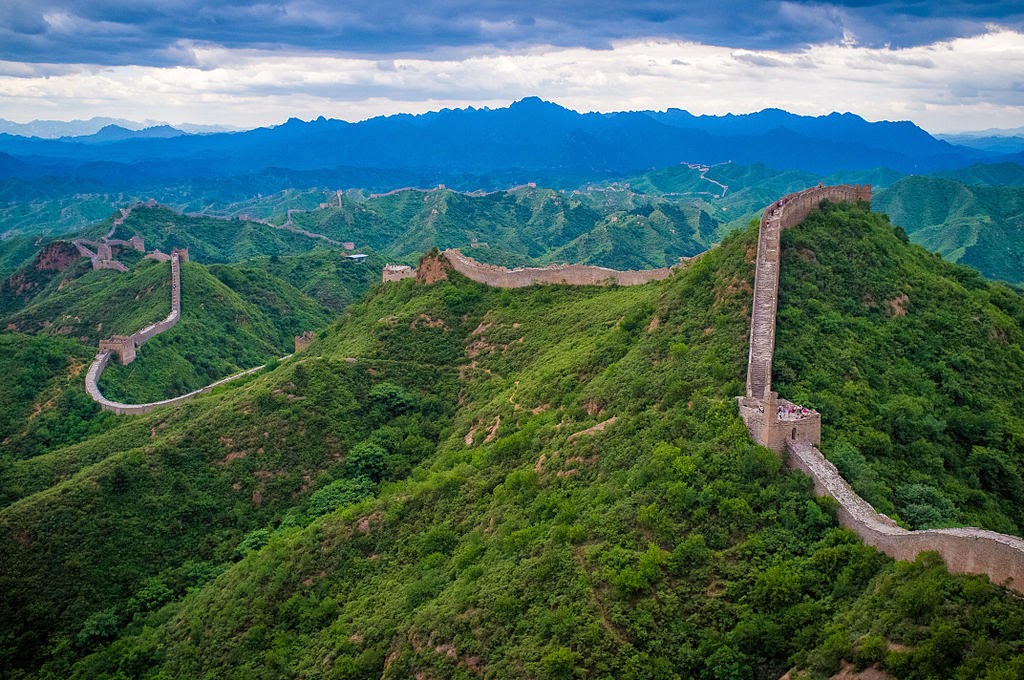
The_Great_Wall_of_China_at_Jinshanling

Compiled from Compton's Living Encyclopedia on America Online (August 1995)
1. HISTORICAL AND CULTURAL CONTINUITY
A significant aspect of China is its long cultural and national history. The Chinese people have shared a common culture longer than any other group on Earth. The Chinese writing system, for example, dates back almost 4,000 years. The imperial dynastic system of government, which continued for centuries, was established as early as 221 BC. Although specific dynasties were overturned, the dynastic system survived. China was even ruled at times by foreign invaders, such as the Mongols during the Yuan Dynasty, from AD 1279 to 1368, and the Manchus during the Ch'ing Dynasty, from AD 1644 to 1911, but the foreigners were largely absorbed into the culture they governed. It is as if the Roman Empire had lasted from the time of the Caesars to the 20th century, and during that time had evolved a cultural system and written language shared by all the peoples of Europe.
The dynastic system was overturned in 1911, and a weak republican form of government existed until 1949. In that year, after a long civil war, the People's Republic of China, with a Communist government, was proclaimed. This government and the ruling Communist party have controlled China ever since. Although the dynastic system has disappeared, the People's Republic occupies essentially the same territory and governs the same people. If anything, the culture and power of China seem stronger in the late 20th century than at almost any other period in history. Under the People's Republic, China's role in world economic and political affairs has grown increasingly more important. Read more on Chinese Cultural Studies, Concise Political History of China 
Source: Brooklyn College.