Showing posts with label The Mexican - American War. Show all posts

Saturday, May 21, 2016

American History; the Alamo: the Real Story (Wild West History Documentary)


THE ALAMO: THE REAL STORY (WILD WEST HISTORY DOCUMENTARY)


The Battle of the Alamo (February 23 – March 6, 1836) was a pivotal event in the Texas Revolution. Following a 13-day siege, Mexican troops under President General Antonio López de Santa Anna launched an assault on the Alamo Mission near San Antonio de Béxar (modern-day San Antonio, Texas, United States), killing all of the Texian defenders. Santa Anna's cruelty during the battle inspired many Texians—both Texas settlers and adventurers from the United States—to join the Texian Army. Buoyed by a desire for revenge, the Texians defeated the Mexican Army at the Battle of San Jacinto, on April 21, 1836, ending the revolution.

This is a drawing of the Alamo Mission in San Antonio. It was first printed in 1854 in Gleason's Pictorial Drawing Room Companion

Several months previously, Texians had driven all Mexican troops out of Mexican Texas. About 100 Texians were then garrisoned at the Alamo. The Texian force grew slightly with the arrival of reinforcements led by eventual Alamo co-commanders James Bowie and William B. Travis. On February 23, approximately 1,500 Mexicans marched into San Antonio de Béxar as the first step in a campaign to retake Texas. For the next 10 days the two armies engaged in several skirmishes with minimal casualties. Aware that his garrison could not withstand an attack by such a large force, Travis wrote multiple letters pleading for more men and supplies, but fewer than 100 reinforcements arrived there.


In the early morning hours of March 6, the Mexican Army advanced on the Alamo. After repulsing two attacks, the Texians were unable to fend off a third attack. As Mexican soldiers scaled the walls, most of the Texian soldiers withdrew into interior buildings. Defenders unable to reach these points were slain by the Mexican cavalry as they attempted to escape. Between five and seven Texians may have surrendered; if so, they were quickly executed. Most eyewitness accounts reported between 182 and 257 Texians died, while most historians of the Alamo agree that around 600 Mexicans were killed or wounded. Several noncombatants were sent to Gonzales to spread word of the Texian defeat. The news sparked both a strong rush to join the Texian army and a panic, known as "The Runaway Scrape", in which the Texian army, most settlers, and the new Republic of Texas government fled from the advancing Mexican Army.


Within Mexico, the battle has often been overshadowed by events from the Mexican–American War of 1846–48. In 19th-century Texas, the Alamo complex gradually became known as a battle site rather than a former mission. The Texas Legislature purchased the land and buildings in the early part of the 20th century and designated the Alamo chapel as an official Texas State Shrine. The Alamo is now "the most popular tourist site in Texas".The Alamo has been the subject of numerous non-fiction works beginning in 1843. Most Americans, however, are more familiar with the myths spread by many of the movie and television adaptations, including the 1950s Disney miniseries Davy Crockett and John Wayne's 1960 film The Alamo.

Credits: Wikipedia

Friday, May 6, 2016

History Documentary: The Mexican - American War Mexican War (1846 to 1848); Full Documentary: the U.S.–Mexican War, or the Invasion of Mexico


The Mexican–American War, also known as the Mexican War, the U.S.–Mexican War or the Invasion of Mexico, was an armed conflict between the United States of America and the United Mexican States from 1846 to 1848. It followed in the wake of the 1845 US annexation of Texas, which Mexico considered part of its territory, despite the 1836 Texas Revolution.

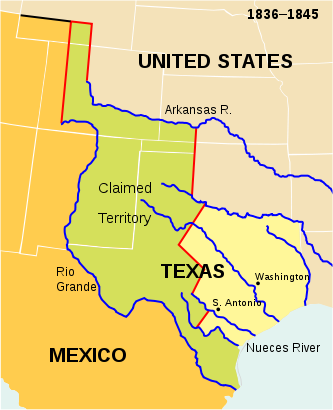
The Republic of Texas. The present-day outlines of the individual US states are superimposed on the boundaries of 1836–1845.

After its independence in 1821 and brief experiment with monarchy, Mexico became a republic in 1824, characterized by considerable instability, so that when war broke out in 1846, Mexico was ill-prepared for this conflict. The war with the United States followed in the wake of decades of Indian raids in the sparsely settled north of Mexico, which the avenger government-sponsored American migration to the Mexican province of Texas was aimed at buffering. Americans and some Mexicans revolted against the Mexican government in the 1836 Texas Revolution, creating a republic not recognized by Mexico, which still claimed it as its national territory. The 1845 expansion of US territory with its annexation of Texas escalated the dispute between the United States and Mexico to open war.

In 1844 James K. Polk, the newly-elected president, made a proposition to the Mexican government to purchase the disputed lands. When that offer was rejected, troops from the United States were moved into the disputed territory of Coahuila. These troops were then attacked by Mexican troops, killing 12 American troops and taking 52 prisoners. These same Mexican troops later laid siege to a US fort along the Rio Grande. This would lead to the conflict that resulted in the loss of much of Mexico's northern territory.

US forces quickly occupied Santa Fe de Nuevo México and Alta California Territory, then invaded parts of Northeastern Mexico and Northwest Mexico; meanwhile, the Pacific Squadron conducted a blockade, and took control of several garrisons on the Pacific coast farther south in Baja California Territory. Another American army, under the command of General Winfield Scott, captured the capital Mexico City, marching from the port of Veracruz, virtually unopposed.

The 1848 Treaty of Guadalupe Hidalgo ended and specified the major consequence of the war: the Mexican Cession of the territories of Alta California and Santa Fe de Nuevo México to the United States in exchange for $15 million. In addition, the United States assumed $3.25 million of debt owed by the Mexican government to US citizens. Mexico recognized the loss of Texas and thereafter cited the Rio Grande as its national border with the United States.

American territorial expansion to the Pacific coast had been the goal of US President James K. Polk, the leader of the Democratic Party. The war was highly controversial in the United States, with the Whig Party, anti-imperialists and anti-slavery elements strongly opposed. Critics in the United States pointed to heavy casualties of the US forces and high monetary cost of the conflict. The war intensified the slavery issue in the United States, leading to bitter debates that culminated in the bloody American Civil War.

In Mexico, the war came in the middle of political turmoil, which increased into chaos during the conflict. The military defeat and loss of territory was a disastrous blow, causing Mexico to enter "a period of self-examination ... as its leaders sought to identify and address the reasons that had led to such a debacle." In the immediate aftermath of the war, some prominent Mexicans wrote that the war that resulted in "the state of degradation and ruin" in Mexico, and saw for "the true origin of the war, it is sufficient to say that the insatiable ambition of the United States, favored by our weakness, caused it." The shift in the Mexico-U.S. border left many Mexican citizens separated from their national government. For the indigenous peoples who had never accepted Mexican rule, the change in border meant conflicts with a new outside power.