The best history documentaries. Traveling from the Middle ages to the industrial revolutions, to understand the past that shaped today's world.
A glimpse into the great ancient Western and Eastern civilizations, America's
history before and after Columbus, Indian and Chinese kingdoms and empires.
Showing posts with label American History. Show all posts
Showing posts with label American History. Show all posts
As the North American colonies of France and Britain expanded, they soon
became conflicted over the strategic Ohio River Valley. The small
battles that followed would grow into a world war that would last 9
years, kill thousands, consume nations and change history forever.
This
movie was part of an English class project we had to do about the
context of a novel, and I read the book "Last of the Mohicans" by James
Fenimore Cooper.
Map showing the 1750 possessions of Britain (pink), France (blue), and Spain (green) in contemporary Canada and the United State
History Documentary: The American Revolutionary War (1775–1783) How Britain Lost The American Colonies (Full Documentary). The Historian Channel's American Independece War, Documentary.
This iconic 1846 lithograph by Nathaniel Currier
was entitled "The Destruction of Tea at Boston Harbor"; the phrase
"Boston Tea Party" had not yet become standard. Contrary to Currier's
depiction, few of the men dumping the tea were actually disguised as
Indians
The American Revolutionary War
(1775–1783), also known as the American War of Independence and the
Revolutionary War in the United States, was the armed conflict between Great
Britain and thirteen of its North American colonies, which had declared
themselves the independent United States of America. Early fighting took place
primarily on the North American continent. France, eager for revenge after its
defeat in the Seven Years' War, signed an alliance with the new nation in 1778
that proved decisive in the ultimate victory. The conflict gradually expanded
into a world war with Britain combating France, Spain, and the Netherlands.
Fighting also broke out in India between the British East India Company and the
French allied Kingdom of Mysore.
The American Revolutionary War had
its origins in the resistance of many Americans to taxes, which they claimed
were unconstitutional, imposed by the British parliament. Patriot protests
escalated into boycotts, and on December 16, 1773, the destruction of a
shipment of tea at the Boston Tea Party. The British government retaliated by
closing the port of Boston and taking away self-government. The Patriots
responded by setting up a shadow government that took control of the province
outside of Boston. Twelve other colonies supported Massachusetts, formed a
Continental Congress to coordinate their resistance, and set up committees and
conventions that effectively seized power. In April 1775 the battles of
Lexington and Concord, in Middlesex County, near Boston, began open armed
conflict between the Kingdom of Great Britain and thirteen of its colonies. The
Continental Congress appointed General George Washington to take charge of
militia units besieging British forces in Boston, forcing them to evacuate the
city in March 1776. Congress supervised the war, giving Washington command of
the new Continental Army; he also coordinated state militia units.
On July 2, 1776, the Continental
Congress formally voted for independence, and issued its Declaration on July 4.
However, it was not until August 2, 1776 that the Declaration of independence
was taken into place and first signed by Delaware. Meanwhile, the British were
mustering forces to suppress the revolt. Sir William Howe outmaneuvered and
defeated Washington, capturing New York City and New Jersey. Washington was
able to capture a Hessian detachment at Trenton and drive the British out of
most of New Jersey. In 1777 Howe's army launched a campaign against the
national capital at Philadelphia, failing to aid Burgoyne's separate invasion
force from Canada. Burgoyne's army was trapped, and surrendered after the
Battles of Saratoga in October 1777.
This American victory encouraged
France to enter the war in 1778. Spain joined the war in 1779, as an ally of
France under the Pacte de Famille.
In 1778, having failed in the
northern states, the British shifted strategy toward the south, bringing
Georgia and South Carolina under control in 1779 and 1780. However, the
resulting surge of Loyalist support was far weaker than expected. In 1781,
British forces moved through Virginia and settled at Yorktown, but their escape
was blocked by a French naval victory in September. Led by Count Rochambeau and
Washington, a combined Franco-American army launched a siege at Yorktown and
captured more than 8,000 British troops in October.
The defeat at Yorktown finally
turned the British Parliament against the war, and in early 1782 they voted to
end offensive operations in North America. The war against France and Spain
continued, with the British defeating the Great Siege of Gibraltar, and
inflicting several defeats on the French in 1782. In 1783, the Treaty of Paris
ended the war and recognized the sovereignty of the United States over the
territory bounded roughly by what is now Canada to the north, Florida to the
south, and the Mississippi River to the west. France gained its revenge and
little else except a heavy national debt, while Spain acquired Great Britain's
Florida colonies.
THE ALAMO: THE REAL STORY (WILD WEST HISTORY DOCUMENTARY)
The Battle of the Alamo (February 23 – March 6, 1836) was a
pivotal event in the Texas Revolution. Following a 13-day siege, Mexican troops
under President General Antonio López de Santa Anna launched an assault on the
Alamo Mission near San Antonio de Béxar (modern-day San Antonio, Texas, United
States), killing all of the Texian defenders. Santa Anna's cruelty during the
battle inspired many Texians—both Texas settlers and adventurers from the
United States—to join the Texian Army. Buoyed by a desire for revenge, the
Texians defeated the Mexican Army at the Battle of San Jacinto, on April 21,
1836, ending the revolution.
This is a drawing of the
Alamo Mission in San Antonio. It was first printed in 1854 in Gleason's
Pictorial Drawing Room Companion
Several months previously, Texians had driven all Mexican
troops out of Mexican Texas. About 100 Texians were then garrisoned at the
Alamo. The Texian force grew slightly with the arrival of reinforcements led by
eventual Alamo co-commanders James Bowie and William B. Travis. On February 23,
approximately 1,500 Mexicans marched into San Antonio de Béxar as the first
step in a campaign to retake Texas. For the next 10 days the two armies engaged
in several skirmishes with minimal casualties. Aware that his garrison could
not withstand an attack by such a large force, Travis wrote multiple letters
pleading for more men and supplies, but fewer than 100 reinforcements arrived
there.
In the early morning hours of March 6, the Mexican Army
advanced on the Alamo. After repulsing two attacks, the Texians were unable to
fend off a third attack. As Mexican soldiers scaled the walls, most of the
Texian soldiers withdrew into interior buildings. Defenders unable to reach
these points were slain by the Mexican cavalry as they attempted to escape.
Between five and seven Texians may have surrendered; if so, they were quickly
executed. Most eyewitness accounts reported between 182 and 257 Texians died,
while most historians of the Alamo agree that around 600 Mexicans were killed
or wounded. Several noncombatants were sent to Gonzales to spread word of the
Texian defeat. The news sparked both a strong rush to join the Texian army and
a panic, known as "The Runaway Scrape", in which the Texian army,
most settlers, and the new Republic of Texas government fled from the advancing
Mexican Army.
Within Mexico, the battle has often been overshadowed by
events from the Mexican–American War of 1846–48. In 19th-century Texas, the
Alamo complex gradually became known as a battle site rather than a former
mission. The Texas Legislature purchased the land and buildings in the early
part of the 20th century and designated the Alamo chapel as an official Texas State
Shrine. The Alamo is now "the most popular tourist site in Texas".The
Alamo has been the subject of numerous non-fiction works beginning in 1843.
Most Americans, however, are more familiar with the myths spread by many of the
movie and television adaptations, including the 1950s Disney miniseries Davy
Crockett and John Wayne's 1960 film The Alamo.
The Mexican–American War, also known as the Mexican War, the
U.S.–Mexican War or the Invasion of Mexico, was an armed conflict between the
United States of America and the United Mexican States from 1846 to 1848. It
followed in the wake of the 1845 US annexation of Texas, which Mexico
considered part of its territory, despite the 1836 Texas Revolution.
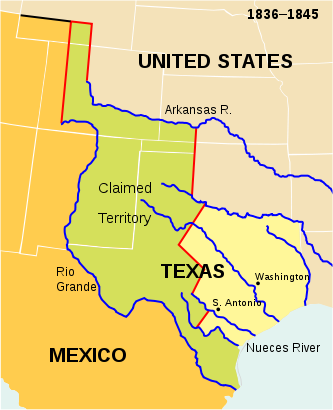
The Republic of Texas. The present-day outlines of the individual US states are superimposed on the boundaries of 1836–1845.
After its independence in 1821 and brief experiment with
monarchy, Mexico became a republic in 1824, characterized by considerable
instability, so that when war broke out in 1846, Mexico was ill-prepared for
this conflict. The war with the United States followed in the wake of
decades of Indian raids in the sparsely settled north of Mexico, which the
avenger government-sponsored American migration to the Mexican province of
Texas was aimed at buffering. Americans and some Mexicans revolted against the
Mexican government in the 1836 Texas Revolution, creating a republic not
recognized by Mexico, which still claimed it as its national territory. The
1845 expansion of US territory with its annexation of Texas escalated the
dispute between the United States and Mexico to open war.
In 1844 James K. Polk, the newly-elected president, made a
proposition to the Mexican government to purchase the disputed lands. When that
offer was rejected, troops from the United States were moved into the disputed
territory of Coahuila. These troops were then attacked by Mexican troops,
killing 12 American troops and taking 52 prisoners. These same Mexican troops
later laid siege to a US fort along the Rio Grande. This would lead to the
conflict that resulted in the loss of much of Mexico's northern territory.
US forces quickly occupied Santa Fe de Nuevo México and Alta
California Territory, then invaded parts of Northeastern Mexico and Northwest
Mexico; meanwhile, the Pacific Squadron conducted a blockade, and took control
of several garrisons on the Pacific coast farther south in Baja California
Territory. Another American army, under the command of General Winfield Scott,
captured the capital Mexico City, marching from the port of Veracruz, virtually
unopposed.
The 1848 Treaty of Guadalupe Hidalgo ended and specified the
major consequence of the war: the Mexican Cession of the territories of Alta
California and Santa Fe de Nuevo México to the United States in exchange for
$15 million. In addition, the United States assumed $3.25 million of debt owed
by the Mexican government to US citizens. Mexico recognized the loss of Texas
and thereafter cited the Rio Grande as its national border with the United
States.
American territorial expansion to the Pacific coast had been
the goal of US President James K. Polk, the leader of the Democratic Party.
The war was highly controversial in the United States, with the Whig Party,
anti-imperialists and anti-slavery elements strongly opposed. Critics in the
United States pointed to heavy casualties of the US forces and high monetary cost
of the conflict. The war intensified the slavery issue in the United States,
leading to bitter debates that culminated in the bloody American Civil War.
In Mexico, the war came in the middle of
political turmoil, which increased into chaos during the conflict. The military
defeat and loss of territory was a disastrous blow, causing Mexico to enter
"a period of self-examination ... as its leaders sought to identify and
address the reasons that had led to such a debacle." In the immediate aftermath
of the war, some prominent Mexicans wrote that the war that resulted in
"the state of degradation and ruin" in Mexico, and saw for "the
true origin of the war, it is sufficient to say that the insatiable ambition of
the United States, favored by our weakness, caused it." The shift in
the Mexico-U.S. border left many Mexican citizens separated from their national
government. For the indigenous peoples who had never accepted Mexican rule, the
change in border meant conflicts with a new outside power.
James Butler Hickok (May 27, 1837 – August 2, 1876)—known as
"Wild Bill" Hickok—was a folk character of the American Old West.
Some of his exploits as reported at the time were fiction, but his skill as a
gunfighter and gambler provided the basis for his fame, along with his
reputation as a lawman.
James Butler Hickok (May 27, 1837 – August 2, 1876)—known as
"Wild Bill" Hickok—
Hickok was born and raised on a farm in rural Illinois. He
went west at age 18 as a fugitive from justice, first working as a stagecoach
driver, then as a lawman in the frontier territories of Kansas and Nebraska. He
fought (and spied) for the Union Army during the American Civil War and gained
publicity after the war as a scout, marksman, actor and professional gambler.
Hickok was involved in several notable shootouts.
He was shot from behind and killed while playing poker in a
saloon in Deadwood, Dakota Territory (now South Dakota) by an unsuccessful
gambler, Jack McCall. The card hand which he supposedly held at the time of his
death (aces and eights) has come to be known as the "Dead Man's
Hand."
History Documentary: The New World, Colonial history of the United States of America; American History, Full Documentary, Historian Channel.
Colonial Williamsburg, View of the reconstructed Raleigh Tavern
on Duke of Gloucester Street
This documentary traces the discovery of America and early voyages by
European explorers. It shows Indian civilizations encountered by the
Spanish, Spanish colonization, English freebooters on the Spanish Main,
and the life of early settlers in New England and the South.
The
colonial history of the United States covers the history of European
settlements from the start of colonization of America until their
incorporation into the United States. In the late 16th century, England,
France, Spain and the Netherlands launched major colonization programs
in eastern North America. Small early attempts often disappeared;
everywhere the death rate of the first arrivals was very high.
Nevertheless successful colonies were established. European settlers
came from a variety of social and religious groups. No aristocrats
settled permanently, but a number of adventurers, soldiers, farmers, and
tradesmen arrived. Diversity was an American characteristic as the
Dutch of New Netherland, the Swedes and Finns of New Sweden, the English
Quakers of Pennsylvania, the English Puritans of New England, the
English settlers of Jamestown, and the "worthy poor" of Georgia, came to
the new continent and built colonies with distinctive social,
religious, political and economic styles. Non-British colonies were
taken over and the inhabitants were all assimilated, unlike in Nova
Scotia, where the British expelled the French Acadian inhabitants. There
were no major civil wars among the 13 colonies, and the two chief armed
rebellions (in Virginia in 1676 and in New York in 1689–91) were
short-lived failures. Wars between the French and the British—the French
and Indian Wars and Father Rale's War—were recurrent, and involved
French support for Wabanaki Confederacy attacks on the frontiers. By
1760 France was defeated and the British seized its colonies.
On
the eastern seaboard of what would become the United States, the four
distinct British regions were: New England, the Middle Colonies, the
Chesapeake Bay Colonies (Upper South) and the Lower South. By the time
European settlers arrived around 1600–1650, the majority of the Native
Americans living in the eastern United States had been ravaged by new
diseases, introduced to them decades before by explorers and sailors.
Colonizers
came from European kingdoms with highly developed military, naval,
governmental and entrepreneurial capabilities. The Spanish and
Portuguese centuries-old experience of conquest and colonization during
the Reconquista, coupled with new oceanic ship navigation skills,
provided the tools, ability, and desire to colonize the New World.
England, France and the Netherlands started colonies in both the West
Indies and North America. They had the ability to build ocean-worthy
ships, but did not have as strong a history of colonization in foreign
lands as did Portugal and Spain. However, English entrepreneurs gave
their colonies a base of merchant-based investment that needed much less
government support.
English colonies:
England made its first
successful efforts at the start of the 17th century for several reasons.
During this era, English proto-nationalism and national assertiveness
blossomed under the threat of Spanish invasion, assisted by a degree of
Protestant militarism and the energy of Queen Elizabeth. At this time,
however, there was no official attempt by the English government to
create a colonial empire. Rather, the motivation behind the founding of
colonies was piecemeal and variable. Practical considerations, such as
commercial enterprise, overpopulation and the desire for freedom of
religion, played their parts. The main waves of settlement came in the
17th century. After 1700 most immigrants to Colonial America arrived as
indentured servants—young unmarried men and women seeking a new life in a
much richer environment. Between the late 1610s and the American
Revolution, the British shipped an estimated 50,000 convicts to its
American colonies. The first convicts to arrive pre-dated the arrival of
the Mayflower.
New England:
New England is the oldest clearly
defined region of the United States. While New England was originally
inhabited by Indigenous peoples, English Pilgrims and especially
Puritans, fleeing religious persecution in England, arrived in the
1620-1660 era. They dominated the region; their religion was later
called Congregationalism. They and their descendants are called Yankees.
Farming, fishing and lumbering prospered, as did seafaring and
merchandising.
Geronimo (Mescalero-Chiricahua: Goyaałé [kòjàːɬɛ́] "the
one who yawns"; June 16, 1829 – February 17, 1909) was a prominent leader
from the Bedonkohe band of the Chiricahua Apache tribe. From 1850 to 1886
Geronimo joined with members of three other Chiricahua Apache bands—the
Chihenne, the Chokonen and the Nednhi—to carry out numerous raids and commit
widespread depredations in the northern Mexico states of Chihuahua and Sonora,
and in the southwestern American territories of New Mexico and Arizona. Geronimo's
raids and related combat actions were a part of the prolonged period of the
Apache-American conflict, that started with American settlement in Apache lands
following the end of the war with Mexico in 1848. The Apache-American conflict
was itself a direct outgrowth of the much older Apache-Mexican conflict which
had been ongoing in the same general area since the beginning of
Mexican/Spanish settlement in the 1600's.